
End the Health Insurance Scam: What They Sell You Isn’t Insurance
What Washington sells you as “health insurance” is not insurance at all — it is prepaid medical care, run through the most expensive billing department ever assembled, and chained to your job by a tax trick from 1943. Insurance belongs in one box on the risk matrix: the rare, ruinous catastrophe. Forcing the routine and the predictable through that same machine is what built a $1,055-a-year administrative tax on every American's existence. Unchain coverage from the job, re-legalize real catastrophic insurance, restore the price tag, and fund the genuinely uninsurable in the daylight.
What you are told is “health insurance” isn’t. And it’s bleeding you DRY!
Health Care Plank: End the Health Insurance Scam — unchain coverage from the job, re-legalize real catastrophic insurance for the rare disaster, restore honest up-front prices, and fund the genuinely uninsurable in the daylight.
“IT WAS NEVER INSURANCE.”
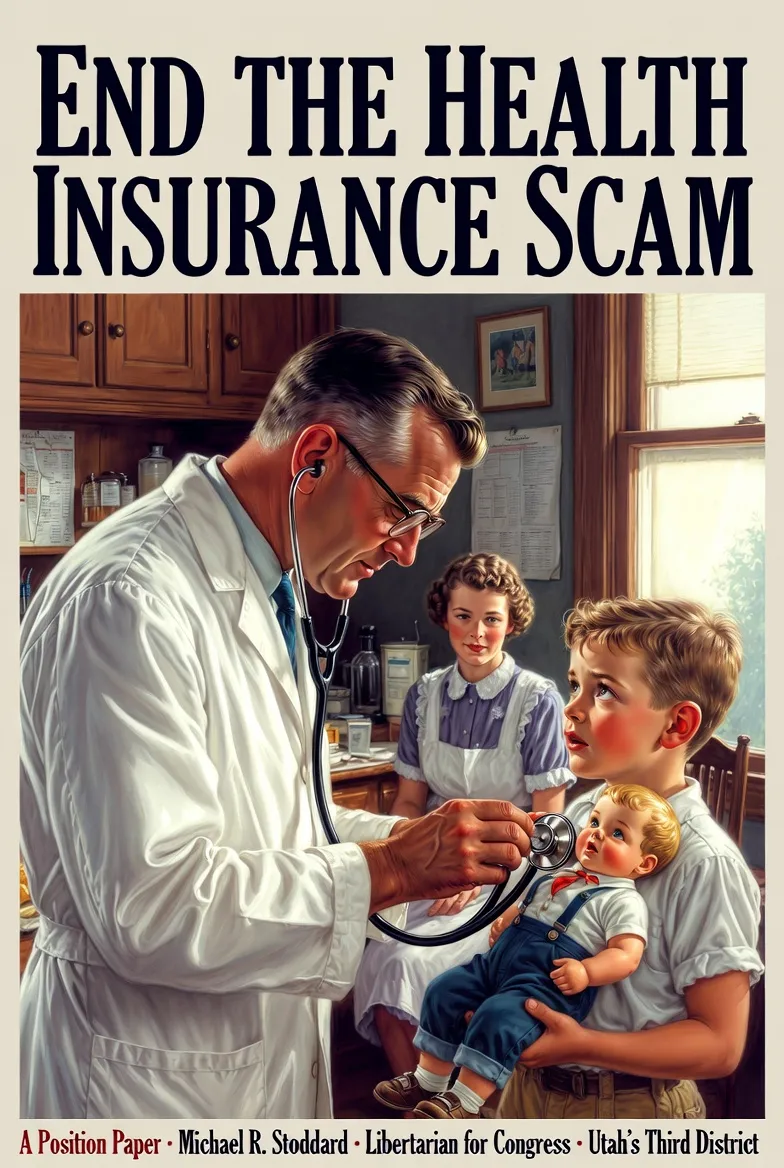
The “Long Con” in one sentence
What Washington sells you as “health insurance” is not insurance at all. It is prepaid medical care, run through the most expensive billing department ever assembled, and chained to your job by a tax trick from 1943. Real insurance is one of the great inventions of Western civilization. What we have is a counterfeit wearing its name — and the counterfeit is the single biggest reason a family of four now pays more for “coverage” than for a mortgage (that mortgage should be half its current size, but that’s another issue for later).
I spent almost forty years as a Certified Public Accountant and a Certified Financial Planner (CFP since 97). I have read more books on finance than I care to remember. When a financial professional sees costs detached from any service rendered, growing year after year while the actual work shrinks, he has a word for it. The word is waste — and when the waste is “engineered” and promoted by law, the word is racket.
Let me show you the engineering. I built a clunky chart (I know I should have AI redraw it 😉) for it years ago. It explains the entire swindle, and once you see it you cannot unsee it.
What insurance is appropriate for and isn’t appropriate for
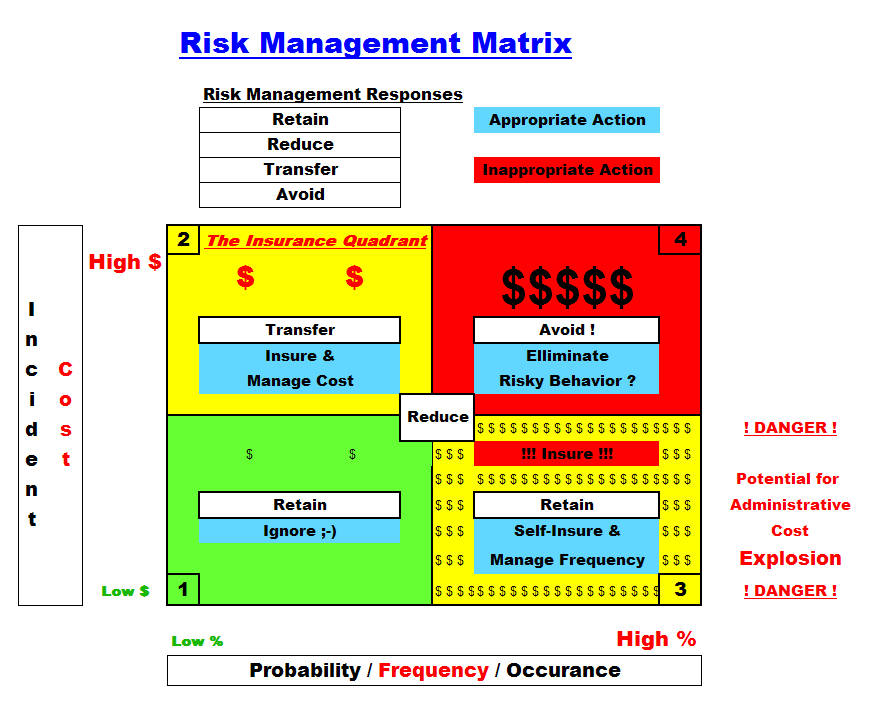
Insurance is an incredible tool. Like any tool, it is right for some jobs and catastrophic for others. You do not use a sledgehammer to set a watch.
Every risk you face in life has two dimensions: how badly it would hurt (the cost of the incident) and how often it happens (the frequency). Put cost on one axis and frequency on the other, and every risk on earth falls into one of four boxes. Each box has exactly one correct response. I call it the Risk Management Matrix, and there are only four moves available to a rational person:
Box 1 — Cheap and rare. A flat tire. A broken dish. Retain the risk. Pay it yourself and forget it. Buying “dish insurance” would be insane.
Box 2 — Expensive and rare. Your house burns down. You get cancer. You wreck the car. Transfer the risk to an insurer. This — and only this — is The Insurance Quadrant. A large pool of people each pay a small, predictable premium so that the rare unlucky member is made whole. The losses are catastrophic but infrequent, so the math works and the overhead stays small. This is what fire insurance, life insurance, and real catastrophic health insurance are for.
Box 3 — Cheap and frequent. Office supplies. Oil changes. Routine checkups. Retain and manage frequency. You pay as you go and you work to need it less. Run these through an insurance company and you have committed a category error — because the paperwork to bill a $40 refill costs nearly as much as the paperwork to bill a $40,000 surgery, and the machine doesn’t care how small the bill is.
Box 4 — Expensive and frequent. This box is a death sentence for any insurance pool. No premium can cover a loss that is both huge and constant. The only rational response is to avoid — change the behavior, exit the situation. You cannot insure a man who sets fire to his own house every morning.
The matrix is not complicated. A bright fourteen-year-old grasps it in five minutes. Which raises the obvious question:
Why is your “health insurance” running almost everything through the wrong box?
The category error that ate one-fifth of the economy
Here is the swindle, laid bare.
Real insurance lives in Box 2 — the rare catastrophe. But American “health insurance” doesn’t stay in Box 2. It reaches down into Box 1 and Box 3 — the routine, the predictable, the high-frequency, low-cost care that you could and should simply buy — and it shoves all of it through the Box 2 transfer machine anyway.
Your annual physical. A strep test. A refilled prescription. A set of stitches. None of these is a rare catastrophe. None of these belongs anywhere near an insurance pool. It is like buying fire insurance to pay for your light bulbs — and then acting surprised when light bulbs start costing four hundred dollars.
Because that is exactly what happens. When you force a routine, frequent, $40 transaction through an insurance mechanism, you bolt onto it a permanent apparatus: claims adjudication, medical coding, prior authorization, network negotiation, billing departments on the provider side and entire bureaucracies on the payer side, all of it duplicated across more than 900 separate private payers running thousands of incompatible plans. The administrative tail doesn’t just wag the dog. The tail becomes the dog.
This is the Box 3 DANGER zone on my matrix — the corner I marked, years ago, “Potential for Administrative Cost Explosion.” It was not a guess. Look at the receipts:
- America now spends roughly $5.3 trillion a year on health care — about eighteen cents of every dollar in the entire economy, north of $15,000 for every man, woman, and child.
- Study after study finds that 15 to 30 percent of that spending is pure administration — paperwork that heals no one. Even the low estimates put the waste in the hundreds of billions of dollars every year. And that share is a blended average dragged down by big-ticket care — a sliver on a major surgery, a far larger cut of every small, routine bill — so it understates exactly the overhead that Box 3 is built on.
- Per person, the United States spends about $1,055 a year just on the administration of health coverage. The next most bureaucratic wealthy nation on earth, Germany, spends $306. We are not 10 percent worse. We are more than three times worse.
Three times the paperwork cost of the next-worst country in the developed world. That is not a bug. That is what Box 1 and Box 3 do when you force them through a Box 2 machine. The explosion was baked into the design.
And here is the second blade of the same knife. When a third party “pays,” the price signal dies. You don’t ask what the MRI costs. The hospital won’t tell you — often can’t tell you — because the real price was buried years ago under negotiated rates, chargemasters, and codes no human can read. A market without prices is not a market. It is a fog. And in the fog, costs only go one direction.
You were not failed by the free market in medicine. There is no free market in American medicine. It was abolished, on purpose, and I can tell you the year.
Who built this, and why it won’t fix itself
The counterfeit was not handed down by nature. It was a corporate “gaming the system” response to ham handed government regulation, and like many expensive disasters in American life, it started with wartime central planning.
In 1942, Washington froze wages. Employers, forbidden by law to compete for scarce workers with higher pay, competed instead with fringe benefits — and the fattest fringe was health coverage. In 1943, the IRS ruled that an employer’s payments for that coverage would not be taxed as the worker’s income. In 1954, Congress wrote the loophole permanently into the tax code.
And there it sits, to this day — the single largest tax break the federal code hands to individuals, and one of the largest it grants to anyone alive: roughly $300 billion a year once you count the payroll tax it dodges too — nearly five times the break you get on your mortgage. But hear me clearly, because the demagogues will twist it: I am not out to tax your health benefits. That $300 billion is not “lost revenue” the Treasury is owed and I mean to claw back — it is the price tag on the rigging, the plain measure of how completely the code has been bent to herd you into a single cage. This was never a tax cut. It is a tax bribe: relief you are allowed to keep only on the condition that you first surrender the money to someone else. It is not welfare for you. It is welfare for the employer-insurer cartel that is robbing you — and you are the one who pays for it.
Read what that tax trick actually does, because it is the black heart of the whole scam. To get the tax break, you must surrender control of your own money to your employer and let him choose & buy your coverage. Workers hand their bosses a share of their earnings that is, on average, more than twice what the tax break saves them — well over a trillion dollars a year of the people’s money, routed through employers and large health care conglomerates instead of through the people who earned it.
Whoever controls the money writes the rules. You don’t control the money. So the insurer answers to your HR department, not to you. The hospital answers to the insurer, not to you. And you — the patient, the customer, the human being whose body is on the table — are the one person in the entire transaction with no leverage at all. You are not the customer. You are the product.
That is why it will not fix itself. And no amount of “regulation” will fix it. Everyone fat off the current arrangement — the payers, the coding industry, the consultants, the captured politicians of both parties — likes it exactly as it is. The explosion is their paycheck.
The hardest question — and I will not dodge it
An honest man states the strongest case against his own position before he states his own. Here is the strongest objection to everything I have written, and it deserves a straight answer.
“Fine. But what about the genuinely sick?” The diabetic. The cancer patient. The child born with a heart defect. Their care is both expensive and constant — that is Box 4, the killer box, the one where no insurance pool can survive and the matrix says avoid. But you cannot tell a Type 1 diabetic to “avoid the risky behavior.” There is no behavior to avoid. The old job-based system, for all its waste, at least dragged the healthy and the sick into one pool together and made the sick affordable. Break that pool apart — let the healthy buy cheap catastrophic plans and pay cash for checkups — and don’t the chronically ill get left to die in the cold?
This is the real question. Anyone who waves it away is a fraud, and I won’t.
Here is my answer — and it begins by correcting a mistake buried in the objection itself. The objection sorts the sick by the bills of the already-diagnosed. But insurance does not price the sick; it prices the risk of becoming sick. Those are two different things, and they fall in two different boxes. The risk of getting cancer, of a child developing diabetes, of a baby arriving with a damaged heart — each is rare, unpredictable, and ruinous. That is Box 2 — the textbook thing insurance is for. What the objection calls Box 4 is not the disease. It is the disease after the risk has already resolved — and the only reason that trap exists is that Washington made it illegal to insure the risk in time.
Cancer is Box 2, full stop. For anyone who carried real coverage before the diagnosis, cancer is exactly the rare, ruinous event a catastrophic plan exists to absorb — the surgery, the chemo, the brutal year, paid. It was never the killer box for them. It becomes Box 4 only for the man who had no policy when the scan lit up — and that man is not a medical category. Hold that thought.
The diabetic child is Box 2 — through the right door. A bare high-deductible plan won’t save him, and I won’t pretend it will: insulin is small and relentless, it lives below the deductible, and a small bill that never stops is its own kind of catastrophe. The tool that works is the one Washington crippled — guaranteed-renewable, health-status coverage — where you insure a healthy child against the risk of becoming the sick one, and the policy converts at diagnosis and can never drop him or jack his rate. You do not insure the diabetes. You insure the healthy years before it — and that insurance is legal almost nowhere in America today.
And the child born with a damaged heart? Conscientious parents should carry that coverage before the pregnancy — before conception, while the risk is still a real and insurable unknown and not a settled fact on an ultrasound. A guaranteed-renewable family policy, bought in good time, travels to the child and stands behind whatever he turns out to need, for as long as he needs it. Let me be plain about what this is and is not: it is not a wager that the baby arrives broken, and any man who frames it that way is lying about it. It is the oldest decent instinct there is — the means laid down in advance, in love, for one who has not yet arrived and cannot yet thank you. Legalize it and watch what a free people do with it. It would make a fine wedding present — grandparents-to-be buying the newlyweds the standing promise that any child of that marriage is already provided for. Insurance built to be given, not merely sold — the kind of honest product an agent could be proud to write and a family proud to give. That market does not exist today because Washington outlawed it. Bring it back.
Now the hard remainder — and it is real. Pull cancer, the diabetic child, and the congenital case out of Box 4, and what is left is not a disease at all. It is a single status: uninsured at the moment the risk came true. The teenager whose parents never bought the policy and the baby whose parents skipped it are, morally, the same innocent — caught at onset with nothing standing behind them. That remainder is not an insurance problem; it is a charity-and-honesty problem, and we treat it like one — in the daylight. And here is the part no honest man can skip: right now that residual is nearly everyone, because the coverage that would have protected them in time is illegal or strangled across most of the country. So today’s already-sick are owed open, funded mercy with no apology and no means test — the system never gave them the chance. In a free system the residual shrinks to the rare few who had the chance and skipped it — and even those we fund, because you do not punish a child for his father’s omission.
What we must never do again is what the current system does: hide them. It buries the cost of the sick inside everyone’s premiums, in the dark, where no one can see the size of the subsidy or vote on it or even name it. That is not compassion — it is a concealed tax, and concealment is the enemy of the sick and the solvent alike. So fund the true residual the honest way: directly, visibly, and accountably. Write the check where the voters can see it. A subsidy you can see is a subsidy you can argue about, cap, and reform. A subsidy buried in a billing code grows forever in the dark.
In other words: open the books on the sick, too. Honesty is not the enemy of mercy. It is the only durable form of it.
What I will do in Congress
I am running on one promise — Open the Books — and the health insurance scam is that promise applied to one-fifth of the economy. The books on American medicine have been closed for eighty years. I intend to open them. Concretely:
- Unchain your coverage from your job. End the 1943 tax trick by equalizing the tax treatment of health dollars. If your employer’s premium is tax-free, so is the cash you spend on your own plan, your own doctor, your own Health Savings Account. The money is yours. Take back the trillion-plus dollars Washington forces you to route through your boss, and put it where it belongs — in your hands.
- Re-legalize real insurance. Make true catastrophic coverage — cheap, lean, Box-2 insurance for the rare disaster — legal and abundant again. Permit guaranteed-renewable and health-status plans that protect people before they get sick. Let plans be sold across state lines so 900 little fiefdoms have to compete for you.
- Restore the price tag. You cannot have a market without prices. Mandate plain, honest, up-front pricing — what the auditor calls transparency and what every other industry on earth calls Tuesday. Unleash Direct Primary Care and cash medicine, where a doctor charges you a flat fee and you never see a claims form. Watch the cost of routine care collapse the moment a patient can read the price.
- Make mercy honest. Fund the care of the genuinely uninsurable directly and in the daylight — not hidden inside everyone’s premium where it metastasizes unseen.
- Get Washington out of Box 1 and Box 3. Stop running light-bulb purchases through the fire-insurance machine. End the mandates that force routine care into the insurance mechanism in the first place. Kill the explosion at its source.
The bottom line
This is not a small reform. It is the difference between a tool used correctly and a tool used as a weapon against the people who pay for it.
Insurance belongs in one box — the rare catastrophe — and it is a blessing there. Everywhere else, it is a billing department with a body count, an $1,055-a-year tax on your existence, a fog machine pumped full by Washington since 1943 to keep you from ever seeing the price.
I am a 75-year-old CPA who has audited governments, raised five children, and read the books no one else wanted to read. I owe my grandchildren a country that doesn’t lie to them about the cost of staying alive. So I’ll say to the health insurance racket exactly what I say to the rest of Washington:
Open the Books, Mr. President.
The Receipts
National health spending, share of GDP, and per-capita figures: Centers for Medicare & Medicaid Services, National Health Expenditure data (2024). Administrative share of spending (15–30%) and waste estimates: Health Affairs, JAMA, and Commonwealth Fund analyses. Per-capita health-administration spending, U.S. ($1,055) vs. Germany ($306): OECD / Peterson-KFF Health System Tracker (2020–21). The employer-coverage tax exclusion — origin in the 1942 wage freeze, 1943 IRS ruling, 1954 codification (IRC §106), and its standing as the largest single individual tax expenditure (~$300B/yr, income and payroll tax combined; reduced rates on capital gains and dividends run a close second): Joint Committee on Taxation (2025–2029 estimates), Tax Policy Center, Congressional Research Service, Bipartisan Policy Center. The coercive structure of the exclusion — workers surrendering ~2× the tax savings in employer control, ~$1.3 trillion routed through employers — and “whoever has the gold makes the rules”: Cato Institute. Number of private payers (900+): industry reporting compiled in healthcare-cost literature. Average employer family premium (>$22,000 in 2021, up ~24% since 2019): KFF Employer Health Benefits Survey / BPC.