
The 15-to-1 Mistake
How a single legislated number — the 15-to-1 gold/silver ratio written into the Coinage Act of 1792 — wrecked American money for a century. Congress did one job well (defining the dollar as a weight) and one job catastrophically (fixing the price between two metals, which only a market can find): set too low in 1792, gold fled; reset too high in 1834, silver fled. The lesson isn't the number — it's that no number set by decree can do the work of a free market.
“…the proportional value of gold to silver … shall be as fifteen to one.”
— Coinage Act of 1792, Sec. 11
A companion to “Restore Sound Money!” — how a single legislated number wrecked American money for a century.
The Constitution hands Congress its money power in a single breath: “To coin Money, regulate the Value thereof, … and fix the Standard of Weights and Measures.” Two jobs are folded into that one clause, and the difference between them is the whole lesson of this paper. One of those jobs the Founders did well. The other they botched so badly that the wreckage ran for over a hundred years — and the botch was not a detail. It was a single number.
Understand what that number did, and you understand why the remedy in my plank is not what my opponents will claim it is.
What Congress Got Right
The Coinage Act of 1792 begins by doing the legitimate thing: it defines the dollar as a weight. A dollar was set at 371¼ grains of pure silver; the gold coins were struck eleven parts fine. And to guard the definition, Sec. 19 made it a felony — punishable by death — for any mint officer to debase the coin. That is the constitutional power working exactly as it should. Defining the dollar as a fixed weight of metal is no different in kind from defining the foot, the pound, or the gallon. It is a definition: made once, then enforced. There is nothing to manage about a definition, and nothing to get wrong year after year. A foot does not need a committee.
What Congress Got Wrong
Then, in the same Act, Congress did something else entirely. Sec. 11 fixed “the proportional value of gold to silver” at fifteen to one — by law. That is not the defining of a weight. That is the setting of a price between two different goods, and a price between two goods is not a fact a legislature gets to declare. It is a fact the market discovers, fresh, every day, as mines open and close and demand shifts around the world. The ratio of gold to silver drifts. It always has. No statute can nail it down any more than a statute can fix the price of wheat against corn.
And drift it did. Within a few years the world market had moved past 15½ toward 16 ounces of silver to one of gold. The law still said 15. The gap was small on paper and catastrophic in practice, because of a rule older than the Republic and more reliable than any legislature.
Gresham’s Law Collects the Bill
The rule is this: when the mint underprices a metal, that metal disappears. People are not fools. If the law values your gold at less than the market will give you for it, you do not bring your gold to the mint — you sell it abroad, melt it, or hoard it, where its full worth is honored. The cheap, overvalued metal stays in circulation; the dear, undervalued metal flees. That is Gresham’s Law, and it is not a quirk. It is the market’s predictable retaliation against a legislated price.
At 15-to-1, gold was the undervalued metal, so gold fled. Coined gold grew scarce; Jefferson suspended silver-dollar coinage in 1806; the “shortage of gold” that puzzled contemporaries was no mystery at all. It was Sec. 11 doing exactly what a mispriced market must do. Here is the supply-and-demand picture as I first worked it out — the diagram that began this whole inquiry:
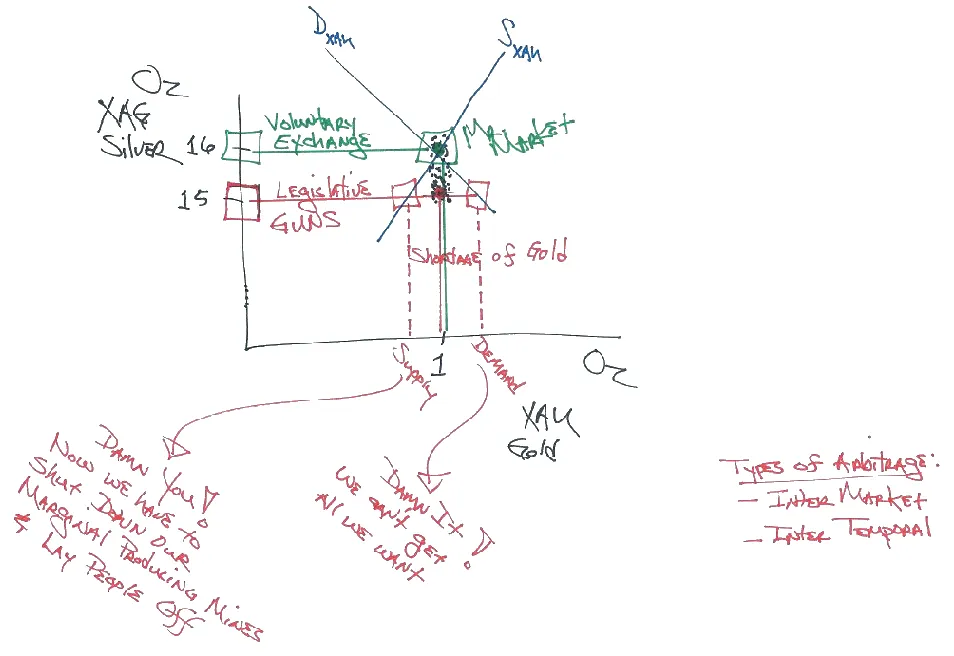
Figure 1 — the author’s original working diagram. The legislated mint price (red, 15) sits below the market price (green, 16); gold is the undervalued metal, and the gap between supply and demand is the shortage of gold.
They Tried Again — and Missed the Other Way
In 1834 the Jacksonians — President Andrew Jackson and his hard-money ally Senator Thomas Hart Benton, “Old Bullion” — set out to fix the mistake by resetting the ratio to roughly sixteen to one, hoping to coax gold back into circulation. It worked, and that is the damning part. Having underpriced gold for forty years, the law now overpriced it. This time the mint price sat above the market rather than below it — a price floor instead of a ceiling — and a price floor produces a glut. Gold flooded into the mint, and the newly underpriced silver did exactly what gold had done before it: it fled. The full-weight silver dollar became worth more melted than spent, and it drained out of the country.
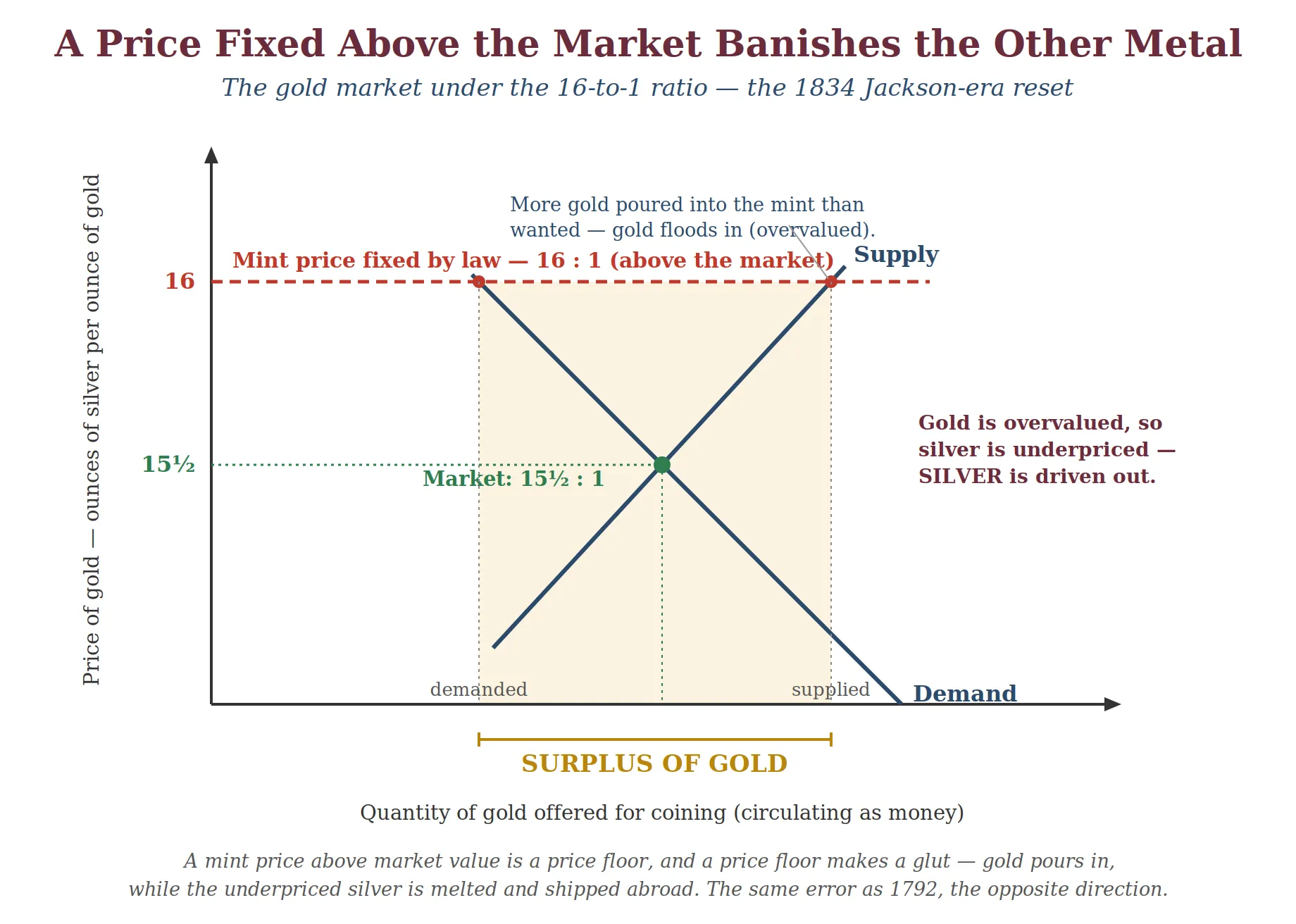
Figure 2 — the same gold market in 1834, the mirror of Figure 1: a price set above the market, a glut of gold, and silver driven out.
Read that twice, because it is the heart of the matter. The legislature could not get the number right in either direction. Set it too low and gold flees; set it too high and silver flees. Eighty years, two resets, the same failure each time — not because the men were unusually stupid, but because the task was impossible. You cannot legislate a price that only a market can discover. The error was never the particular number. The error was believing a number should be legislated at all.
The Coin That Wore a Costume
This is where the popular story goes wrong, including the story told by most precious-metals “experts.” They will tell you America had silver money until 1964. That is true only if you count the metal and ignore the standard. By 1834 the silver standard was already finished in practice — the dollar had been driven out of circulation. In 1873 Congress formally demonetized the standard silver dollar, the so-called “Crime of ‘73,” though it merely signed the death certificate of a coin that had been gone for decades.
Then, in 1878, the silver dollar came back — but not as honest money. Under pressure from the western mining states, Congress had the Treasury buy silver at its depressed market price and strike it into dollars whose metal was worth well under a dollar. Those coins circulated at face value for one reason only: the law said they must. That is the precise structure of a token — fiat wearing a silver face. It was minted to consume the ore of Nevada and Colorado and to buy the Free-Silver vote, and most of the coins never circulated at all; they sat in vaults backing paper certificates. The coin wore the 1792 specifications like a costume. The weight was real; the standard behind it was not.
A careful objector will press: the silver was genuinely in the coin, and the certificates were backed by genuine silver in the vault — how is that fiat? Because backing by quantity is not backing by value. A standard is a promise that the unit equals a weight, redeemable at par by anyone who brings metal to the mint. A pile of below-par dollars in a vault is collateral for a token, not an anchor for a standard. So the honest answer is the uncomfortable one: we did not lose silver money in 1964. We lost it in 1834, when a legislated number drove the metal out. 1964 was merely the year the costume finally came off.
The Real Lesson: Definition, Not Discretion
It is tempting to draw the lazy conclusion — “Congress is hopeless with money, so hand it to the experts.” That is exactly the reasoning that gave us the Federal Reserve in 1913, and it asks the wrong question. The question is not who should hold the money power. It is whether anyone should hold discretionary power over money at all.
Look at the record honestly. Congress wrecked the money with discretion from 1792 to 1900. The Federal Reserve has wrecked it with discretion since 1913. The arsonist simply changed addresses. The fire is the same fire, and its name is discretion — the standing power to set a number, target a quantity, manage a supply. Wherever that power sits, elected or appointed, it will be abused, because it is the power to do the impossible: to declare by decree a value that only a free market can find.
So when an opponent says my plank would hand the printing press back to a divided and incompetent Congress, he has read it backward. I do not want to move the printing press from the Federal Reserve to Capitol Hill. I want to take it away from both. Congress’s only legitimate monetary task is the one it performed well in 1792: define the dollar as a fixed weight of gold and silver, guarantee honest coinage, and punish debasement — and then step aside and let the metals find their own ratio in the open market, through free coinage, the way every other price is found. Article I gives Congress the power to fix the standard. It does not give Congress — or anyone — the power to run the money.
That is not turning back the clock. It is refusing, at last, to let any single legislated number do another century of damage. Define the dollar, and leave the price to the people.
Restore sound money. Open the books. And never again trust one number, set by decree, to do the work of a free market.
Honest-Money Mike
Exhibit — The Statute Itself
The annotated page below is from the Coinage Act of 1792, the United States’ first monetary law. Sections 11 through 13 are where Congress moved from defining the dollar as a weight to fixing the gold-to-silver ratio at fifteen to one — the single number that triggered Gresham’s Law and a century of monetary havoc.
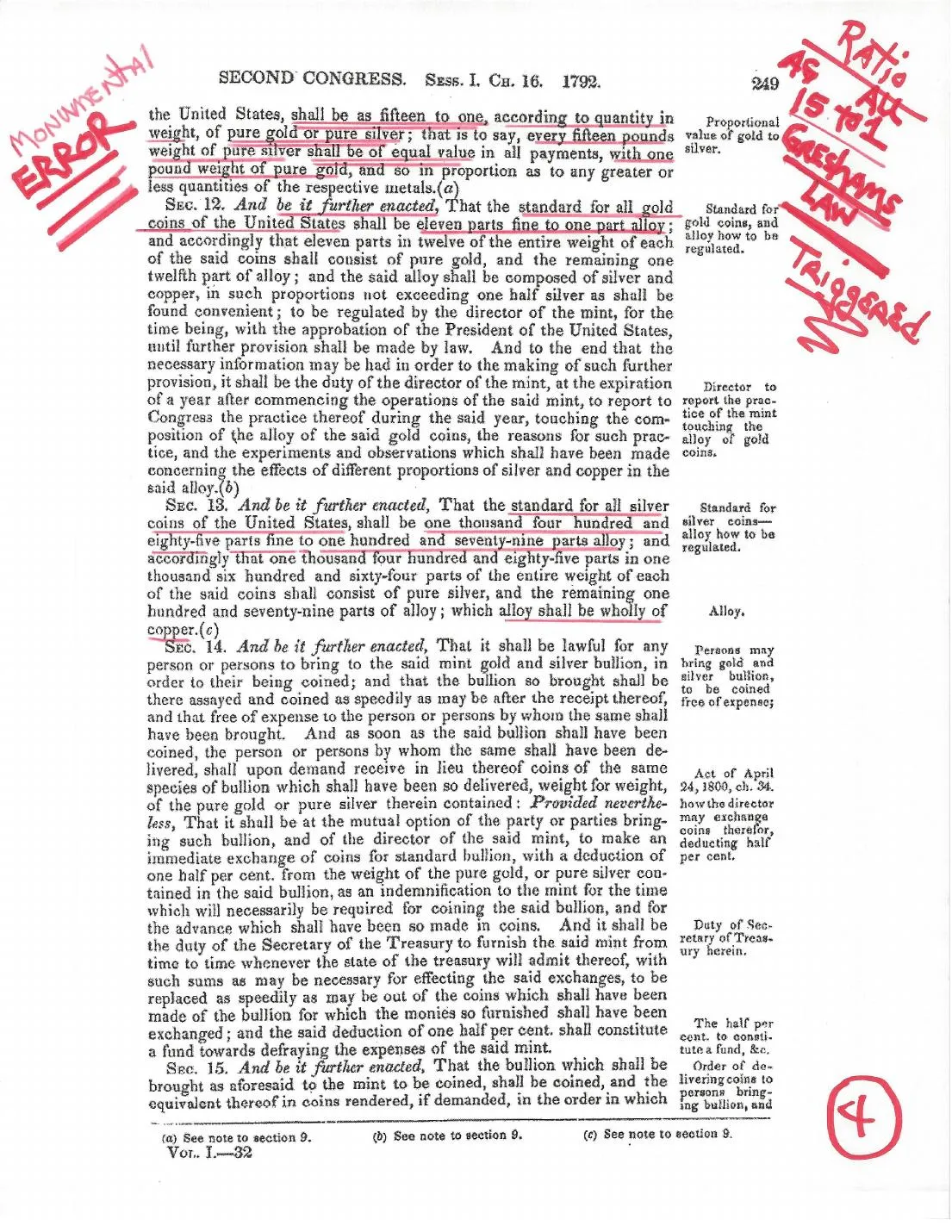
Coinage Act of 1792, Statute I, Ch. 16, p. 249 (Sec. 11–13). The full six-page annotated statute is available as a separate exhibit: The Coinage Act of 1792, Annotated.