Gresham's Law as a Price Control
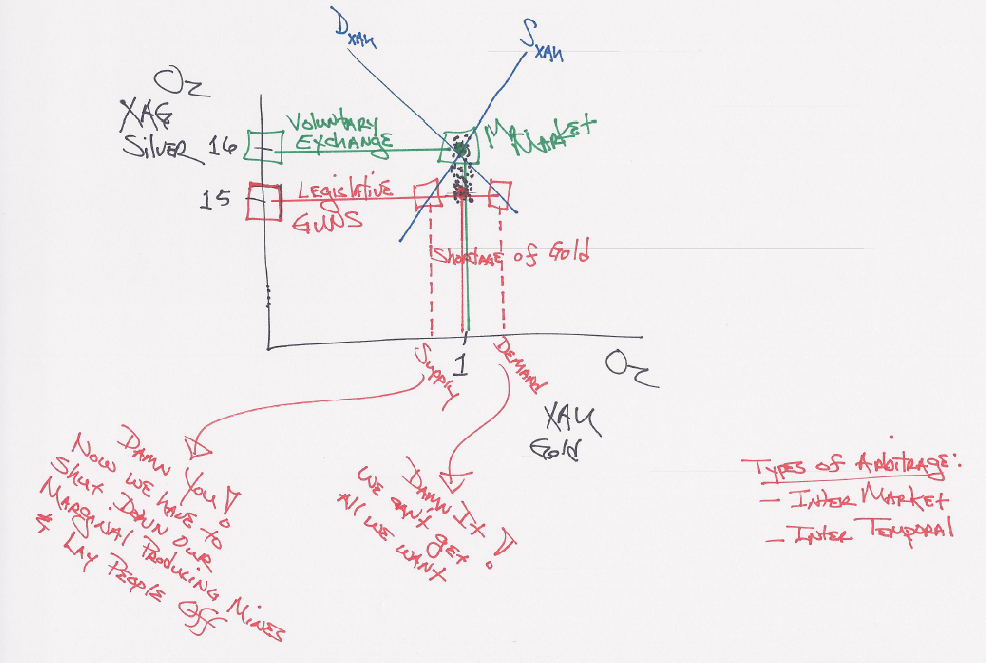
The candidate's hand-drawn diagram of Gresham's Law, drawn as what it really is — a price control. A ratio between gold and silver isn't something a legislature can declare; it's a price between two goods, and a price is what the market discovers as mines open and close and demand shifts. The sketch marks that market ratio 16, but no one sets it — it could be 20 or 30. The Coinage Act of 1792 instead fixed it at 15 by law ('legislative guns'); underprice a metal by decree and the market retaliates the only way it can — the underpriced gold is melted, hoarded, or shipped where its full worth is honored, and a shortage opens. Gold vanishes purely as the predictable response to a legislated price.
The candidate’s hand-drawn diagram shows Gresham’s Law for what it is: a price control.
Start with the distinction the whole sound-money argument turns on. Defining the dollar as a fixed weight of silver is a legitimate act — it is like defining the foot or the pound, a standard set once and then enforced. Fixing the ratio between gold and silver is a different thing entirely: it sets a price between two goods, and a price is not a fact a legislature can declare. It is a fact the market discovers, fresh, as mines open and close and demand shifts around the world. (The companion paper The 15-to-1 Mistake follows that distinction through both the 1792 and 1834 statutes.)
Read the chart as plain supply and demand. The vertical axis is the price of gold measured in ounces of silver; the horizontal axis is the quantity of gold. Gold’s supply and demand curves cross where voluntary exchange would settle — the sketch marks that point 16, but the number is incidental. No one sets it; left alone it could be 16, 20, 30 — whatever buyers and sellers reach.
The Coinage Act of 1792 instead fixed the ratio at 15 by law — the line the drawing labels “legislative guns,” because a legislated price is backed by force. Pin that legal price below where the market would clear, and you have a binding price ceiling on gold. The response is not mysterious; it is the market’s predictable retaliation against a legislated price. Gold is now legally underpriced, so gold flees: the marginal mines go dark — “now we have to shut down our marginal producing mines and lay people off” — buyers “can’t get all they want,” and the metal is melted, hoarded, or shipped abroad to wherever its full worth is honored. A shortage opens in the gap between supply and demand.
That is the whole of Gresham’s Law: gold disappears from circulation purely as the market’s answer to a price set by decree, exactly as any good would if the law forbade it from selling for what it is worth. The error was never the particular number; it was believing the number could be legislated at all.
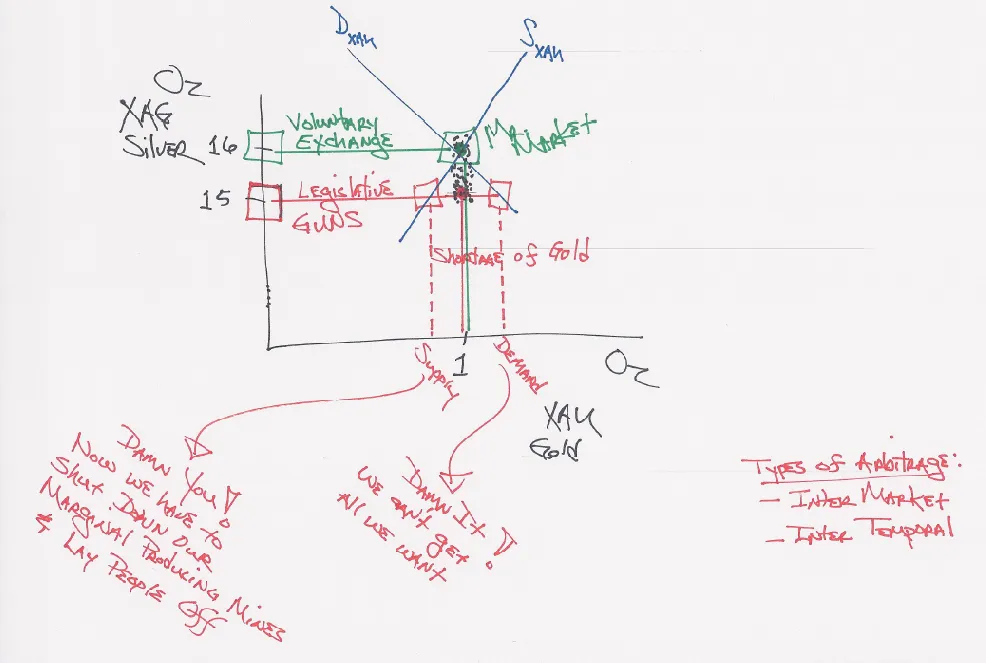
The candidate’s original working diagram. View full size. The same mechanism runs in reverse when a legislated ratio is set too high — see The 15-to-1 Mistake, which traces both the 1792 and 1834 cases.